1. Design an original complex of connected rooms/spaces. DO NOT use the complex in the example below. Create a drawing of your complex. It should have multiple paths to some rooms. You can use PowerPoint for this.
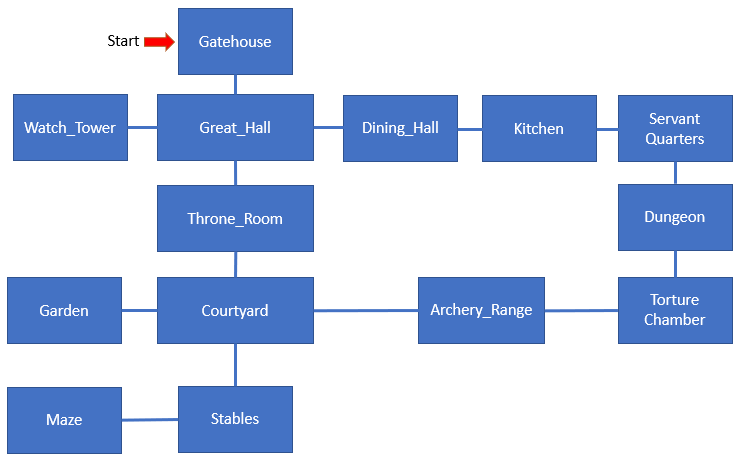
2. Create vertex.txt and edge.txt
Create an original complex of connected rooms/spaces
(at least 10 rooms). Read
in the vertices and edges from files. Allow the user to move around the
complex by going North, South, East, and West. Implement ASCII art that
shows the user which way they can move. Implement Dijkstra's
algorithm to find the shortest path to a user selected room. Create a
drawing of your complex. Upload the following files to Ecampus: (1)
Drawing of complex, (2) Java source code, (3) vertex.txt, (4) edge.txt
1. Design an original complex of connected rooms/spaces. DO NOT use
the complex in the example below. Create a drawing of your complex. It should have multiple paths to some
rooms. You can use PowerPoint for this.
2. Create vertex.txt and edge.txt
| vertex.txt contains room names: GateHouse Great_Hall Dining_Hall Throne_Room |
edge.txt contains room connections: GateHouse South Great_Hall Great_Hall South Throne_Room Great_Hall East Dining_Hall Great_Hall South Throne_Room |
3. Create the Room class. There are two variables used for Dijkstra's
algorithm.
class Room
{
    String RoomName;
    Room North, South, East, West;
    boolean Visited;   // used for Dijkstra
    int Distance;      // used for Dijkstra

    Room (String theRoomName)
    {  RoomName = theRoomName;  }
}
4. Create the main program that reads in the vertices and edges. The
vertices go into the Vertex ArrayList. Rooms are connected according to
the edges. You can start with the program below.
import java.io.*;
import java.util.*;
public class castle
{
	static ArrayList<Room> Vertex = new ArrayList<Room>();
	static ArrayList<Room> Path = new ArrayList<Room>();

	public static void main(String[] args) throws IOException
	{
		Scanner in = new Scanner(System.in);

		// read in vertices
		File file = new File("vertex.txt");
		Scanner infile = new Scanner(file);
		String Input = "";
		while (infile.hasNextLine())
		{
			Input = infile.nextLine();
			Vertex.add(new Room(Input));
		}
		System.out.println(Vertex.size() + " vertices read from file");

		// read in edges
		file = new File("edge.txt");
		infile = new Scanner(file);
		String From, Direction, To;
		int Count=0;
		while (infile.hasNext())
		{
			Count++;
			From = infile.next();
			Direction = infile.next();
			To = infile.next();
			// Uncomment this line to help debug runtime error reading edge.txt
			// System.out.println("From: " + From + " Direction: " + Direction + " To: " + To);

			// locate From Vertex in ArrayList
			int IndexFrom = 0;
			while (!Vertex.get(IndexFrom).RoomName.equals(From))
			{  IndexFrom++;  }
			// locate To Vertex in ArrayList
			int IndexTo = 0;
			while (!Vertex.get(IndexTo).RoomName.equals(To))
			{  IndexTo++;  }
			// create edge
			if (Direction.equals("North"))
			{
				Vertex.get(IndexFrom).North = Vertex.get(IndexTo);
				Vertex.get(IndexTo).South = Vertex.get(IndexFrom);
			}
			if (Direction.equals("South"))
			{
				Vertex.get(IndexFrom).South = Vertex.get(IndexTo);
				Vertex.get(IndexTo).North = Vertex.get(IndexFrom);
			}
			if (Direction.equals("East"))
			{
				Vertex.get(IndexFrom).East = Vertex.get(IndexTo);
				Vertex.get(IndexTo).West = Vertex.get(IndexFrom);
			}
			if (Direction.equals("West"))
			{
				Vertex.get(IndexFrom).West = Vertex.get(IndexTo);
				Vertex.get(IndexTo).East = Vertex.get(IndexFrom);
			}
		}
		System.out.println(Count + " edges read from file");
		System.out.println("Press <Enter> to Continue");
		Choice = in.nextLine();
	}
}
5. Write code to allow the user to move around the rooms and find the shortest path to another room. Have ASCII art that shows the user the directions they can move.
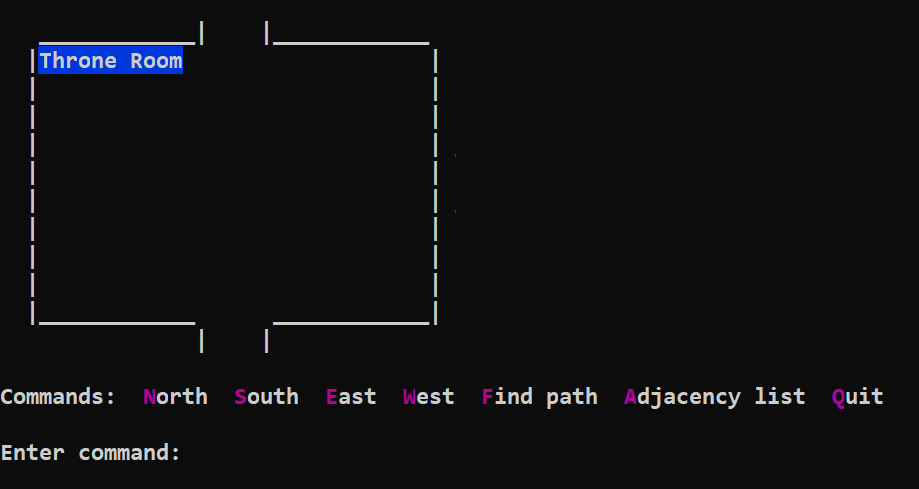
To print the path, step through the Path ArrayList and print the RoomName.
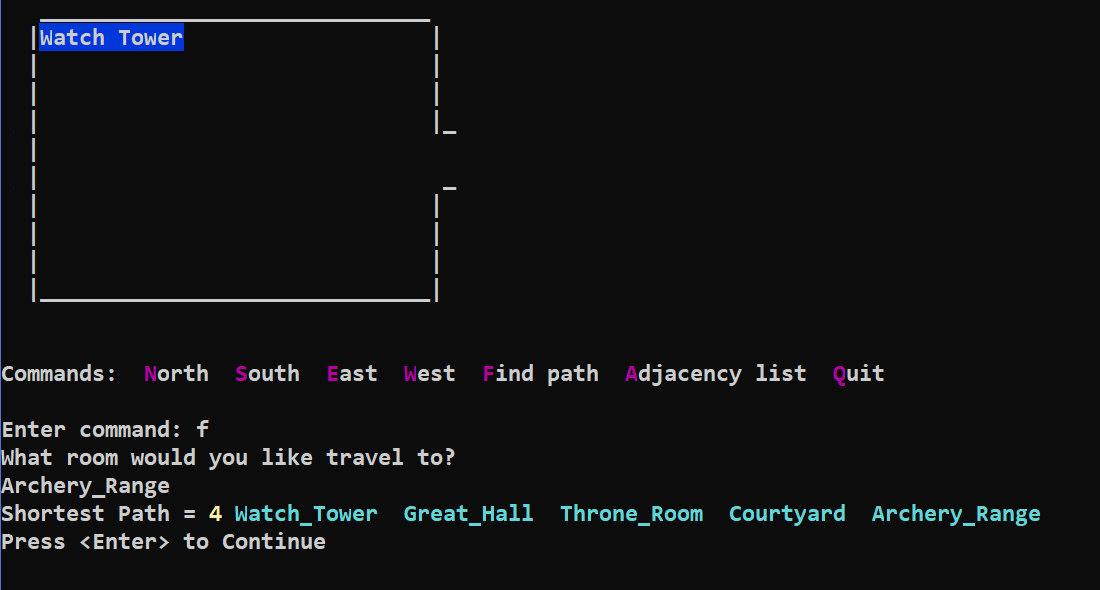
To print the adjacency list after finding a path, step through the Vertex
ArrayList and print the Distance and RoomName.
	static void Dijkstra(Room Start, Room Finish)
	{
		// set distance to all rooms (except for Start) to 1000 and visited = false
		for (int i=0; i<Vertex.size(); i++)
		{
			if (Vertex.get(i) == Start)
				Vertex.get(i).Distance = 0;
			else
				Vertex.get(i).Distance = 1000;  // set distance to "infinity"
			Vertex.get(i).Visited = false;
		}
		// Do Dijkstra - find Distance to each room
		Room Temp = Start;
		while (!Finish.Visited)
		{
			Temp.Visited = true;
			if (Temp.North!=null && !Temp.North.Visited && Temp.North.Distance > Temp.Distance+1)
				Temp.North.Distance = 1 + Temp.Distance;
			if (Temp.South!=null && !Temp.South.Visited && Temp.South.Distance > Temp.Distance+1)
				Temp.South.Distance = 1 + Temp.Distance;
			if (Temp.East!=null && !Temp.East.Visited && Temp.East.Distance > Temp.Distance+1)
				Temp.East.Distance = 1 + Temp.Distance;
			if (Temp.West!=null && !Temp.West.Visited && Temp.West.Distance > Temp.Distance+1)
				Temp.West.Distance = 1 + Temp.Distance;

			int Smallest = 1000;
			int SmallestIndex = 0;
			for (int i=0; i<Vertex.size(); i++)
			{
				if (!Vertex.get(i).Visited && Vertex.get(i).Distance < Smallest)
				{
					Smallest = Vertex.get(i).Distance;
					SmallestIndex = i;
				}
			}
			Temp = Vertex.get(SmallestIndex);
		}

		// populate Path ArrayList with Rooms of shortest path
		Temp = Finish;
		Path.clear();
		Path.add(0,Finish);
		while (Temp != Start)
		{
			int N = 1000, S = 1000, E = 1000, W = 1000;
			if (Temp.North != null)  N = Temp.North.Distance;
			if (Temp.South != null)  S = Temp.South.Distance;
			if (Temp.East != null)  E = Temp.East.Distance;
			if (Temp.West != null)  W = Temp.West.Distance;
			if (N < S && N < E && N < W)
				Temp = Temp.North;
			else if (S < E && S < W)
				Temp = Temp.South;
			else if (E < W)
				Temp = Temp.East;
			else
				Temp = Temp.West;
			Path.add(0,Temp);
		}
	}